Halal Family Vacation Savings Plan: 2026 Guide
TL;DR:
- A halal family vacation savings plan is a structured, faith-aligned strategy that funds travel using interest-free, Shariah-compliant tools. Families should set a realistic cost target, use halal savings accounts, and contribute consistently to reach their travel goals effectively. Starting with an emergency fund and automating savings are essential for maintaining financial stability and fulfilling Islamic obligations.
A halal family vacation savings plan is a structured, faith-aligned budgeting and saving strategy that helps Muslim families fund travel without engaging in interest-based financial products. The standard industry term for this approach is Islamic financial planning, and it applies the same principles used for Hajj and Umrah savings to everyday family travel goals. Building this kind of plan requires three things: an accurate cost target, a halal-compliant savings vehicle, and a consistent monthly contribution. Families who start with all three in place reach their travel goals faster and with far less financial stress.
1. How to build your halal family vacation savings plan
The first step is setting a realistic cost target. A family vacation to a Muslim-majority destination like Turkey or Malaysia will cost far less than a trip to Western Europe, but both require deliberate planning. Your savings goal must cover flights, accommodation, meals, local transport, and a buffer for unexpected costs.

Hidden expenses add 20–30% to the base cost of any family trip. That buffer covers private transfers, travel insurance, vaccinations, and emergency spending. Build that percentage into your target from day one, not as an afterthought.
The table below shows sample budget ranges for a family of four across three destination types and two travel windows.
| Destination type | Off-peak estimate | Peak season estimate |
|---|---|---|
| Budget halal destination (Tunisia, Turkey) | $4,000–$6,000 | $7,000–$10,000 |
| Mid-range halal destination (Malaysia, Jordan) | $7,000–$11,000 | $12,000–$16,000 |
| Western Europe (UK, France) | $12,000–$18,000 | $18,000–$25,000 |
These ranges include the 20–30% hidden cost buffer. Use them as a starting point, then adjust for your family size and travel style.
2. Which halal savings accounts and methods work best
Dedicated halal savings accounts are the foundation of any Muslim family travel savings plan. In the United States, FDIC and NCUA-insured options include Stearns Bank, UIF, LARIBA, and Jafari Credit Union, all of which operate on Shariah-compliant, interest-free structures. These accounts keep your funds safe and your savings free from riba.
For saving horizons longer than two years, a liquid account alone is not enough. Inflation erodes purchasing power over time, so pairing a liquid halal savings account with Shariah-screened investments protects your target amount in real terms. Move funds from investments back to liquid accounts 6–12 months before your departure date to avoid exposure to market swings close to travel time.
The bucket strategy is the most practical framework for this:
- Liquid bucket (30%): Held in a halal savings account for near-term needs and emergencies
- Growth bucket (70%): Placed in Shariah-screened funds for saving horizons of 3–5 years
- Glide path rule: Shift funds from growth to liquid 6–12 months before departure
Pro Tip: Link your automated monthly transfer to your payday. Automation beats willpower every time, and payday transfers remove the temptation to spend before saving.
3. What timing and booking strategies cut costs most
Off-peak travel months like may and september reduce family vacation costs by 20–40%. That is not a minor discount. On a $10,000 trip, a 30% reduction saves $3,000 that can stay in your savings account or fund a longer stay.
Budget-friendly halal destinations amplify this further. Tunisia and Turkey offer package prices 30–50% lower than comparable Western European trips. Both countries have strong halal infrastructure, including halal-certified hotels, women-only pool hours, and family-oriented kids’ clubs.
Booking 3–6 months in advance adds another layer of savings. Early booking yields 20–30% savings on family packages, especially for Ramadan or summer travel periods when halal-certified hotels offer kids-stay-free deals. Combine early booking with loyalty program points for maximum cost reduction.
Key timing tactics for affordable halal trips:
- Travel in may, september, or early october to avoid peak pricing
- Book flights and hotels together as a package when possible
- Target destinations with established halal infrastructure to avoid costly workarounds
- Stack loyalty rewards with early bird rates for the deepest discounts
Pro Tip: Off-peak travel does not just save money. Better access to halal amenities like women-only pools and kids’ clubs is more likely when resorts are less crowded.
4. How to integrate vacation saving into your household financial plan
Vacation saving belongs inside your broader household financial plan, not outside it. Islamic financial planning recommends building an emergency fund covering 3–6 months of living expenses before directing money toward travel goals. That emergency fund is non-negotiable. Without it, one unexpected expense wipes out months of vacation savings.
Once your emergency fund is in place, allocate 20–30% of monthly income to savings, including zakat obligations. Vacation savings come from within that allocation, not on top of it. This keeps your overall financial structure sound and your obligations to Allah fulfilled first.
A practical framework for integrating vacation saving looks like this:
- Calculate your monthly income after zakat. Zakat comes first. Work from the post-zakat figure for all other allocations.
- Fund your emergency account to the 3–6 month target. Do not start vacation saving until this is complete.
- Set your vacation savings line item. Treat it like a fixed monthly bill inside your 20–30% savings allocation.
- Open a separate, labeled account for travel funds. Mixing vacation money with daily spending is the fastest way to lose track of progress.
- Review your allocation every six months. Income changes, family needs shift, and your savings rate should reflect reality.
Amanahfund’s family halal budget setup principles follow this same sequence, treating zakat and emergency funds as the foundation before any discretionary saving goal.
5. How much to save monthly and for how long
The numbers are straightforward. Saving $200–$350 monthly over 3–5 years builds a fund of $7,200–$21,000. That range covers most mid-range halal family vacations for a family of four, including the hidden cost buffer.
Families with shorter timelines need higher monthly contributions or lower-cost destinations. A family targeting a $6,000 trip in 18 months needs to save roughly $333 per month. A family with a $12,000 goal and a 3-year horizon needs $333 per month as well, which shows how destination choice and timeline interact directly.
Treat your monthly vacation contribution as a cash-flow decision. Redirecting non-essential expenses into monthly contributions is more effective than trying to save large lump sums. Dining out less, canceling unused subscriptions, and redirecting those amounts to your travel account adds up faster than most families expect.
6. Practical tools for managing your savings system
A dedicated, labeled savings account is the single most effective tool for managing Islamic vacation planning funds. Keeping vacation funds separate from daily spending prevents fund mixing and makes progress visible. Name the account something specific, like “Family Turkey Trip 2027,” so every family member connects the balance to a real goal.
Beyond the account structure, these practices keep your system running:
- Automate transfers on payday. Set the transfer to move the moment your income arrives. Do not leave it as a manual task.
- Track progress monthly. Review your balance against your target every month. Adjust contributions if income changes.
- Avoid partial withdrawals. Dipping into vacation funds for non-travel expenses is the most common reason families miss their goals. Treat the account as untouchable.
- Use a halal budgeting app. Amanahfund tracks spending with halal-aware categories, calculates zakat, and supports dedicated savings goals for travel, Hajj, Umrah, and Eid. It connects securely through Plaid and provides AI-assisted transaction categorization.
Pro Tip: Review your halal savings strategies annually. What worked in year one may need adjustment as your family grows or your income changes.
Key takeaways
A successful halal family vacation savings plan requires a clear cost target, a Shariah-compliant savings structure, and consistent monthly contributions that fit within your household’s broader Islamic financial obligations.
| Point | Details |
|---|---|
| Set a realistic cost target | Include a 20–30% buffer for hidden costs like transfers, insurance, and emergencies. |
| Use halal savings accounts | FDIC or NCUA-insured options like Stearns Bank and UIF keep funds riba-free. |
| Apply the bucket strategy | Split funds 30% liquid and 70% invested for saving horizons of 3–5 years. |
| Travel off-peak to save 20–40% | May and september trips to destinations like Turkey cut costs significantly. |
| Automate and separate funds | Link transfers to payday and keep vacation money in a dedicated, labeled account. |
Why I think most Muslim families plan vacations backward
Most families I speak with start by picking a destination, then figure out how to pay for it. That sequence creates financial stress and, too often, leads to interest-based financing that compromises the halal nature of the trip itself.
The families who travel well, and travel without guilt, start with the savings structure. They open the account, set the monthly transfer, and then choose the destination that fits the fund they have built. That order matters enormously.
There is also a spiritual dimension that gets overlooked in most travel finance advice. Saving is an act of worship when the intention is to create barakah for your family and to travel in a way that honors your deen. That mindset is not just motivational language. It is what keeps families consistent when competing financial pressures make it tempting to redirect the vacation fund toward something else.
My honest advice: build your emergency fund first, set your zakat aside, then automate your vacation contribution. Do not wait until you feel financially comfortable to start. Start with whatever amount is realistic, even if it is $100 a month, and increase it as your income grows. Patience and consistency are the actual tools here. The destination is just the reward.
— Imran
Amanahfund and your family travel savings goals
Muslim families deserve financial tools that reflect their values, not generic apps that treat interest as a feature.
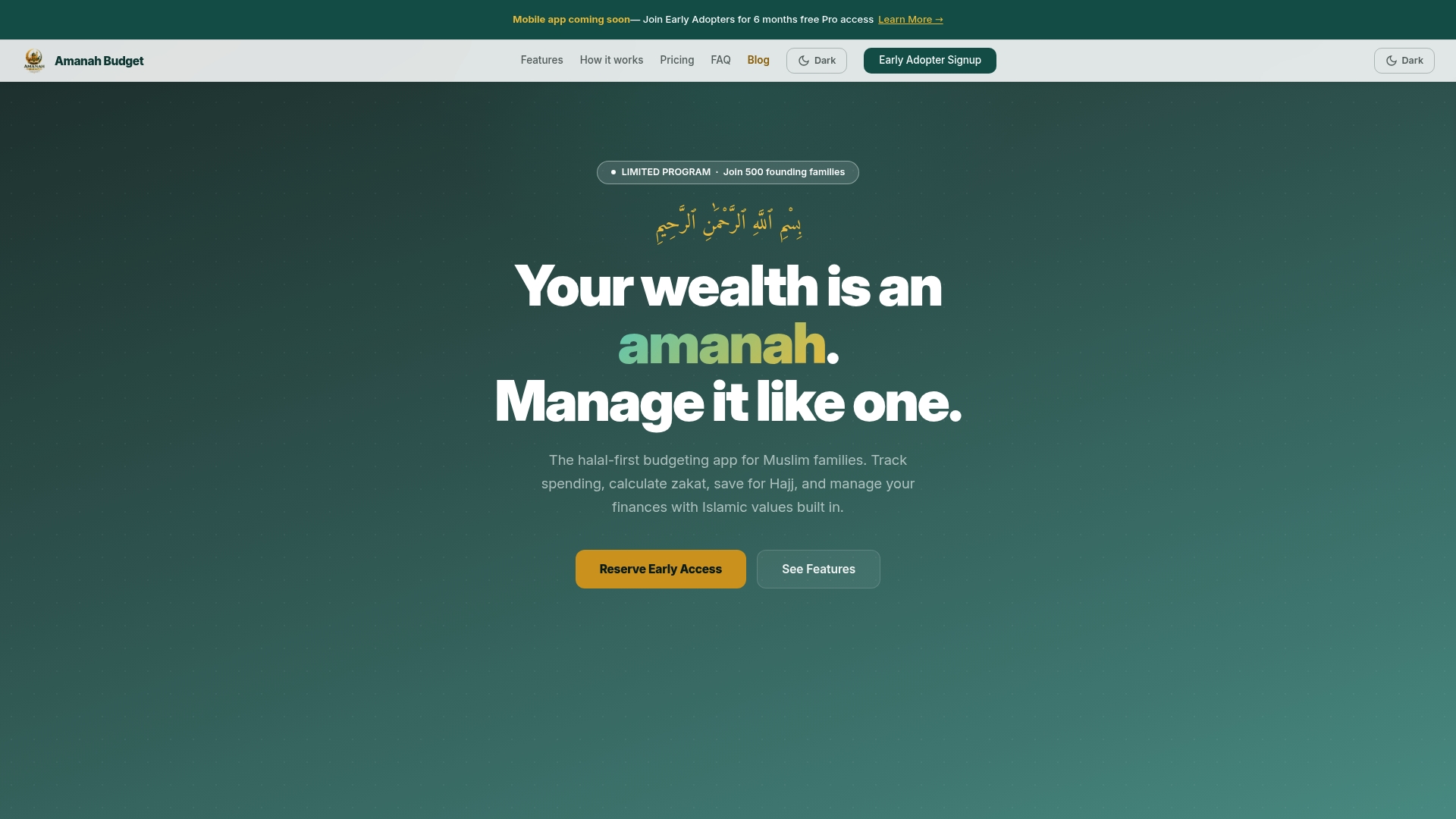
Amanahfund is built specifically for Muslim households. It supports dedicated savings goals for travel, Hajj, Umrah, Ramadan, and Eid, with halal-aware spending categories and zakat calculation built in from the start. You can share your household budget with your spouse, connect your bank accounts securely through Plaid, and track your vacation fund progress in real time. Visit Amanahfund.com to set up your faith-aligned family budget and start building toward the trip your family deserves.
FAQ
What is a halal family vacation savings plan?
A halal family vacation savings plan is a structured saving strategy that funds family travel using interest-free, Shariah-compliant financial tools. It combines a realistic cost target, dedicated halal savings accounts, and automated monthly contributions.
How much should I save each month for a halal family vacation?
Saving $200–$350 per month over 3–5 years builds a fund of $7,200–$21,000, which covers most mid-range halal family vacations for a family of four including hidden costs.
Which halal savings accounts are available in the United States?
FDIC and NCUA-insured options include Stearns Bank, UIF, LARIBA, and Jafari Credit Union. All four operate on interest-free, Shariah-compliant structures.
When is the best time to travel for affordable halal trips?
Off-peak months like may and september reduce costs by 20–40%. Budget halal destinations like Tunisia and Turkey offer package prices 30–50% lower than Western Europe during these windows.
Should I save for vacation before building an emergency fund?
No. Islamic financial planning recommends completing a 3–6 month emergency fund before directing savings toward travel goals. Vacation saving belongs within your broader 20–30% monthly savings allocation, not before your financial foundation is secure.
Recommended
Ready to manage your amanah?
Track halal spending, calculate zakat, save for Hajj — all in one app. Free forever.
Create Free Account