HSA Account Halal Use Explained for Muslim Families
TL;DR:
- A halal Health Savings Account (HSA) complies with Islamic finance principles by avoiding interest and investing in Shariah-compliant funds. Proper management involves minimizing cash earning riba, investing immediately, and using the invest-and-reimburse method for medical expenses. IRS limits for 2026 allow families to save and grow healthcare funds tax-free, supporting long-term halal financial planning.
A halal Health Savings Account (HSA) is a tax-advantaged medical savings account structured to comply with Islamic finance principles, avoiding riba and ensuring investments align with Shariah guidelines. The hsa account halal use explained simply: the account itself is neutral, but your choices about investments and cash management determine its halal status. Many Islamic scholars permit HSA use in the United States under the principle of darurah, or necessity, because preserving life is a core objective of maqasid al-Shariah. With 2026 IRS contribution limits set at $4,400 for individuals and $8,750 for families, the tax advantages make this one of the most powerful halal savings tools available to Muslim families today.
How do HSAs work and why are they halal in Islamic finance?
A Health Savings Account is a tax-sheltered account available to people enrolled in a qualifying High-Deductible Health Plan (HDHP). Contributions go in pre-tax, grow tax-free, and come out tax-free when used for qualified medical expenses. That triple tax benefit is rare in the American financial system.

From an Islamic finance perspective, health insurance is permissible under the principle of darurah, which recognizes necessity as a valid reason to engage with otherwise complex financial structures. Scholars widely view employer-provided HDHP and HSA combinations as the most accessible and affordable coverage path for American Muslims. The HSA itself does not charge interest or generate riba by design.
The Islamic legal case rests on maqasid al-Shariah, specifically the preservation of life and health. Using an HSA is halal and encouraged by many scholars precisely because it supports responsible medical expense management. The account structure aligns with Islamic financial stewardship: spend only on genuine needs, save intentionally, and avoid waste.
Key features that make HSAs compatible with halal financial planning:
- Contributions reduce taxable income, keeping more wealth in your household
- Funds roll over indefinitely with no “use it or lose it” rule
- No required minimum distributions at any age
- After age 65, funds can be withdrawn for any purpose and taxed as ordinary income, without penalty
What are halal investment options for HSAs and how do you avoid riba?
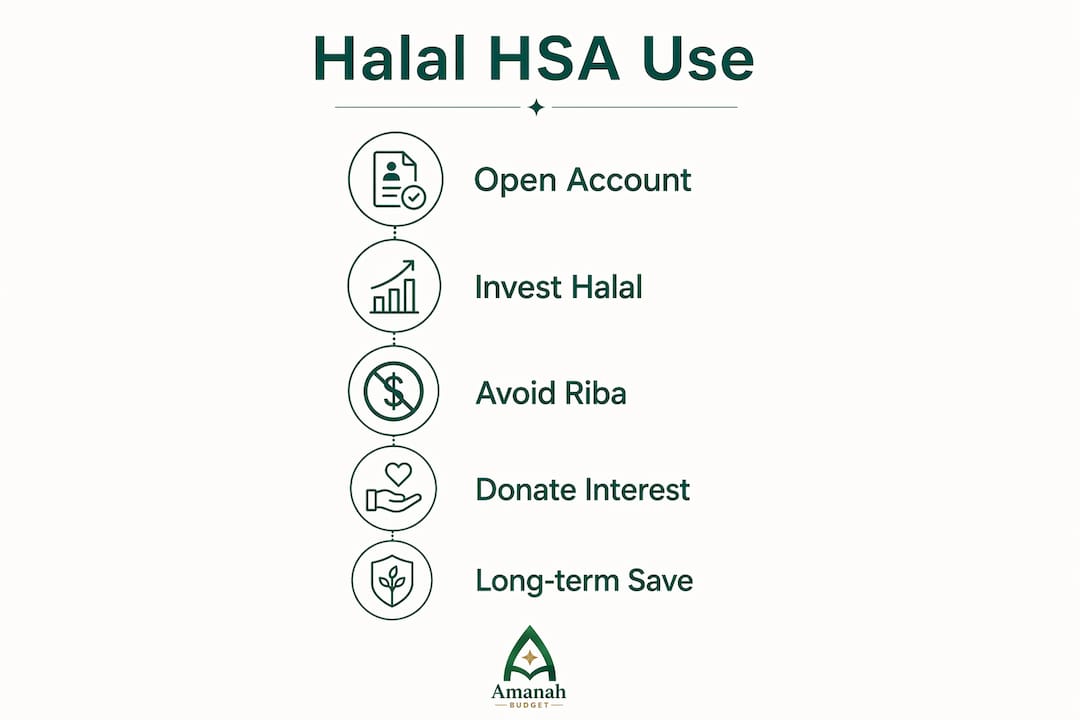
The biggest halal concern with HSAs is not the account itself. It is the idle cash that most providers automatically place in interest-bearing sweep accounts. Most HSA providers pay interest on idle cash at rates between 0.05% and 0.5%, which still constitutes riba under Islamic law. The solution is to minimize cash exposure and invest immediately in Shariah-compliant funds.
Shariah-compliant ETFs and mutual funds for HSAs
Several halal investment options are available within HSA accounts at providers that allow self-directed investing:
- SPUS (SP Funds S&P 500 Shariah ETF): Tracks a Shariah-screened version of the S&P 500 with an expense ratio of 0.49%, lower than the average actively managed fund at around 0.91%
- HLAL (Wahed FTSE USA Shariah ETF): A broad Shariah-screened US equity fund with accessible pricing
- Amana Growth Fund: A long-standing Shariah-compliant mutual fund with a strong track record in Islamic investing
Managing the riba problem in cash accounts
When your HSA provider does not offer a non-interest-bearing cash option, the accepted scholarly guidance is to donate any interest earned to charity without claiming a tax deduction. This purifies the account without benefiting from the riba. Selecting providers that allow non-interest-bearing cash options is the preferred approach.
Muslims can also perform in-service rollovers from employer-assigned HSAs to independent, self-directed HSAs. This preserves employer contributions while opening access to a broader halal investment menu. Providers like Fidelity allow investments in halal ETFs and mutual funds within HSAs, making this transfer practical for most families.
Pro Tip: Set up automatic investing within your HSA so contributions move into your chosen halal ETF within one to two business days of deposit. This keeps idle cash exposure as brief as possible.
How can Muslims ethically use an HSA for medical expenses and long-term savings?
Ethical use of an HSA means spending only on IRS-qualified medical expenses and treating the account as a long-term savings vehicle, not a medical checking account. Qualified expenses include doctor visits, prescriptions, dental care, vision care, and hearing aids, as defined in IRS Publication 502. Non-qualified withdrawals before age 65 trigger income tax plus a 20% penalty. That penalty alone is a strong reason to use HSA funds carefully and intentionally.
The invest-and-reimburse method
The most powerful halal strategy for HSA use is the invest-and-reimburse method. Here is how it works:
- Pay medical expenses out of pocket. Use your regular bank account or debit card for all qualified medical costs.
- Save every receipt. The IRS allows indefinite time to reimburse yourself after the HSA is established, so documentation is critical.
- Invest your HSA contributions immediately in a Shariah-compliant ETF like SPUS or HLAL.
- Let the funds grow tax-free for years or even decades in halal investments.
- Reimburse yourself later by withdrawing the exact amount of documented expenses, completely tax-free.
The invest-and-reimburse strategy turns your HSA into a long-term halal growth vehicle rather than a short-term spending account. A family that pays $3,000 in annual medical expenses out of pocket while keeping $3,000 invested in SPUS for 20 years builds a substantial tax-free reserve for future healthcare costs in retirement.
Most people miss this opportunity by treating the HSA like a checking account. Treating it as a dedicated retirement health savings vehicle maximizes the halal benefits of the account structure.
Pro Tip: Create a dedicated folder, physical or digital, labeled “HSA Receipts” and store every qualified medical expense document there. Organize by year and amount so reimbursements are clean and auditable.
Halal savings goals and the HSA
The HSA fits naturally into a broader halal financial plan. Families saving for Hajj, Umrah, or education can benefit from the same discipline that the invest-and-reimburse method requires: spend intentionally now, grow savings patiently, and withdraw with purpose. Amanahfund’s guidance on halal savings account types places the HSA within a full picture of Islamic savings structures available to American Muslim families.
What are the current IRS rules and contribution limits for HSAs?
The 2026 IRS contribution limits represent a meaningful opportunity for Muslim families to build tax-free healthcare savings. Understanding the rules prevents costly mistakes and keeps the account compliant with both IRS requirements and Islamic financial principles.
| HSA Rule | 2026 Details |
|---|---|
| Individual contribution limit | $4,400 per year |
| Family contribution limit | $8,750 per year |
| Catch-up contribution (age 55+) | Additional $1,000 per year |
| HDHP minimum deductible (individual) | Required to open and contribute |
| Non-qualified withdrawal penalty (under 65) | Income tax plus 20% penalty |
| After age 65 withdrawal | Taxed as ordinary income, no penalty |
| Carryover rule | Unused funds roll over indefinitely |
Maxing the family contribution can save approximately $3,200 in total taxes depending on your tax bracket. That is real wealth preserved for your family rather than paid to the government. Employer contributions count toward the annual limit, so coordinate with your HR department to avoid over-contributing.
The HDHP requirement is non-negotiable. You must be enrolled in a qualifying high-deductible health plan to contribute to an HSA in any given year. You can still spend existing HSA funds if you later switch to a non-HDHP plan, but you cannot make new contributions. Families should review their plan enrollment each november during open enrollment to confirm HDHP eligibility for the coming year.
Key Takeaways
An HSA is halal when you actively manage investments in Shariah-compliant funds, minimize idle cash exposure, and use withdrawals only for IRS-qualified medical expenses.
| Point | Details |
|---|---|
| HSA permissibility | Scholars permit HSA use under darurah; the account structure itself does not generate riba. |
| Halal investment choices | SPUS, HLAL, and Amana Growth Fund are Shariah-screened options available within self-directed HSAs. |
| Riba management | Minimize idle cash and donate any interest earned to charity without claiming a tax deduction. |
| Invest-and-reimburse method | Pay expenses out of pocket, save receipts, invest HSA funds in halal ETFs, and reimburse yourself tax-free later. |
| 2026 contribution limits | Families can contribute up to $8,750 annually, with a $1,000 catch-up for those 55 and older. |
My honest take on managing a halal HSA
I have watched Muslim families leave serious money on the table by treating their HSA like a debit card for co-pays. The account sits in cash, earns a tiny amount of interest nobody notices, and never grows. That passive approach creates two problems at once: riba exposure and missed halal growth.
The fix is not complicated, but it requires intention. You have to actively choose where your HSA money goes. The moment a contribution lands, it should move into a Shariah-compliant ETF. That one habit, done consistently, changes the entire character of the account.
The invest-and-reimburse method feels counterintuitive at first. Paying medical bills from your checking account when you have HSA funds available seems unnecessary. But the math is clear. Tax-free growth over 10 or 20 years on money that would otherwise sit idle is a significant advantage. The receipts folder is the only administrative burden, and it is worth it.
My caution is this: do not let perfect be the enemy of good. If your employer’s HSA provider does not offer halal ETFs, roll it over to a self-directed account. If you earn a few cents of interest before you can invest, donate it. The goal is continuous improvement toward full halal compliance, not paralysis waiting for a perfect system.
The HSA, managed with intention, is one of the most powerful halal financial tools available to American Muslim families right now. Treat it like the amanah it is.
— Imran
Amanahfund and your halal financial plan
Managing a halal HSA is one piece of a larger picture. Muslim families who want their entire financial life to reflect their values need tools built with those values in mind from the start.
Amanahfund is a halal-first budgeting app built specifically for Muslim families. It includes halal-aware spending categories, zakat calculation, and dedicated savings goals for Hajj, Umrah, Ramadan, and emergencies. Families can share budgets, connect bank accounts securely through Plaid, and receive AI-assisted transaction categorization. If you want to see how halal savings strategies fit into a complete Islamic financial plan, Amanahfund is built to show you exactly that. No ads, no interest-based products, and no selling your data.
FAQ
Is an HSA account halal for Muslim families?
Yes. An HSA is halal when managed correctly. Scholars permit its use under the Islamic principle of darurah, and the account itself does not generate riba as long as you invest in Shariah-compliant funds and minimize idle cash.
What halal investment options are available inside an HSA?
Shariah-screened ETFs like SPUS and HLAL, along with the Amana Growth Fund, are available through self-directed HSA providers. SPUS carries an expense ratio of 0.49%, making it a cost-effective halal option.
How do I handle interest earned on HSA cash?
Donate any interest earned to charity without claiming a tax deduction. This purifies the account. The better long-term solution is to transfer your HSA to a provider that offers a non-interest-bearing cash option.
What is the invest-and-reimburse method?
You pay qualified medical expenses out of pocket, save the receipts, and keep your HSA funds invested in halal ETFs. The IRS allows indefinite reimbursement, so you can withdraw the documented amount tax-free years later.
What are the 2026 HSA contribution limits?
The 2026 limits are $4,400 for individuals and $8,750 for families. People aged 55 and older can contribute an additional $1,000 as a catch-up contribution.
Recommended
Ready to manage your amanah?
Track halal spending, calculate zakat, save for Hajj — all in one app. Free forever.
Create Free Account