Muslim Household Income Tracking Tips for 2026
TL;DR:
- Muslim household income tracking involves regularly auditing halal income sources to ensure ongoing compliance. Families categorize expenses using Islamic priorities and calculate zakat accurately based on individual net wealth. Weekly reviews help maintain financial discipline aligned with faith and family goals.
Muslim household income tracking is a disciplined process that integrates Islamic values with practical money management to ensure halal earnings, responsible spending, and financial resilience. Most generic budgeting advice ignores the obligations that shape a Muslim family’s financial life: zakat, nafaqah, and the prohibition of riba. The standard industry term for this practice is Islamic personal finance management, and it goes well beyond recording transactions. These muslim household income tracking tips give you a faith-anchored system that works in real life.
1. Muslim household income tracking tips: start with a halal income audit
The first step in any sound income management plan for Muslim families is confirming that every income source is halal. This is not a one-time check. It is an ongoing habit that protects the barakah in your earnings.
Common halal income sources include employment wages, halal business profits, rental income from permissible properties, and freelance work in lawful fields. Haram income sources include interest payments, income from businesses selling alcohol or pork, and earnings from gambling platforms.
- Review every income stream once per quarter
- Flag any source with unclear halal status for a scholar’s review
- If accidental haram income enters your account, give the equivalent amount as sadaqah without expecting reward
For households earning under $75,000, income growth strategies matter more than granular expense tracking. Fixing the income side first reduces the pressure of survival budgeting.
Pro Tip: Set a calendar reminder every three months labeled “halal income review.” Treat it like a bill payment. Missing it has real spiritual and financial consequences.

2. Conduct a riba audit on all existing accounts
A riba audit means reviewing every financial product you hold for interest-bearing terms. This includes savings accounts, credit cards, car loans, and mortgages. Auditing interest-bearing products and prioritizing their removal is a core step in halal financial planning.
Start by listing every account and its interest rate. Then rank them by urgency: high-interest credit card debt comes before a low-rate car loan. Create a payoff timeline and track progress monthly.
The riba audit is not just a spiritual exercise. Eliminating interest payments frees up real cash for savings, zakat, and family goals. Many families discover they are paying hundreds of dollars per month in interest they had stopped noticing.
3. Use Islamic-intent categories to track expenses meaningfully
Replacing generic budget categories with spiritually aligned categories transforms how a household sees its money. Food vs. rent tells you nothing about your priorities. Obligations vs. halal necessities does.
The five core Islamic-intent categories are:
- Obligations: Zakat, debt repayments, and nafaqah contributions
- Halal necessities: Groceries, rent or mortgage on a halal vehicle, utilities, and medical care
- Halal discretionary: Dining out at halal restaurants, clothing, entertainment that is permissible
- Charity beyond zakat: Sadaqah, sponsoring an orphan, local masjid donations
- Questionable expenses: Any spending that needs a scholar’s review before repeating
| Category | Example Expenses | Priority |
|---|---|---|
| Obligations | Zakat, debt payments | First |
| Halal necessities | Rent, groceries, utilities | Second |
| Charity beyond zakat | Sadaqah, masjid donations | Third |
| Halal discretionary | Halal dining, clothing | Fourth |
| Questionable | Unclear subscriptions | Review before spending |
Pro Tip: Label your bank transactions with these five category codes in a spreadsheet or app. After 30 days, the pattern shows you exactly where your values and your spending diverge.
The best budgeting strategy for Muslim families allocates fixed percentages to obligations first, then necessities, then charity, then savings, and finally discretionary spending. That order is not arbitrary. It reflects Islamic financial priorities directly.
4. Calculate and prioritize zakat in your financial tracking
Zakat is 2.5% of qualifying net wealth above the nisab threshold, held for a full lunar year. It is not a monthly expense. Treating zakat as a dynamic annual obligation rather than a static monthly line item prevents year-end shortfalls and planning errors.
Many families make the mistake of budgeting a fixed monthly zakat amount. The correct approach calculates total net wealth once per lunar year and deducts 2.5% from that figure. If your wealth fluctuates, your zakat amount changes too.
Practical steps for zakat management:
- Set your zakat anniversary date, typically the month you first reached nisab
- Open a dedicated zakat savings account or envelope
- Deposit a monthly estimate throughout the year to avoid a lump-sum shock
- Recalculate the exact amount on your anniversary date and adjust
- Distribute zakat to eligible recipients within a reasonable time after calculation
Each spouse calculates zakat individually based on their own wealth. Zakat per spouse is determined by each person’s nisab threshold, not the household total. Use the complete zakat calculation guide to confirm your nisab figure for 2026.
Islamic financial planning requires prioritizing what you owe, including zakat and debts, before savings or investments. This sequence is not optional.
5. Build a halal emergency fund in compliant savings vehicles
A halal emergency fund covers 3–6 months of essential household expenses. Storing emergency savings in halal accounts prevents riba accrual while keeping funds accessible. This is the financial cushion that protects your family from taking on haram debt during a crisis.
Where to keep halal emergency savings:
- Non-interest checking or savings accounts: Many credit unions and Islamic banks offer these
- Gold or silver: Physical precious metals are a traditional halal store of value
- Islamic money market funds: Available through some halal investment platforms
- Cash at home: Practical for small emergency reserves, though not ideal for large amounts
| Savings Vehicle | Halal Status | Liquidity | Risk Level |
|---|---|---|---|
| Non-interest savings account | Halal | High | Very low |
| Physical gold | Halal | Medium | Medium |
| Islamic money market fund | Halal | Medium | Low |
| Conventional savings account | Haram (riba) | High | Very low |
Build the fund gradually. Start with one month of expenses as your target, then extend to three months, then six. Automating a fixed transfer on payday removes the decision from your hands entirely. Review types of halal savings accounts to find the right vehicle for your situation.
6. Apply shared budgeting strategies for Muslim couples
The three-account system is the most practical structure for Muslim couples. Separate and joint accounts preserve Islamic financial autonomy while enabling coordinated household management. Each spouse keeps a personal account, and a third joint account covers shared household expenses.
How the system works in practice:
- The husband contributes nafaqah to the joint account to cover housing, food, and family needs
- The wife’s personal wealth remains her own and is not obligated for household expenses
- Both spouses contribute to joint savings goals like Hajj, Umrah, or a home purchase by agreement
- Each spouse tracks personal discretionary spending independently
Communication is the most common failure point in joint budgeting. Schedule a monthly money meeting with a clear agenda: review joint account balances, confirm zakat estimates, and discuss upcoming large expenses. Keep it under 30 minutes. The household budget share guide provides a ready-made framework for structuring these conversations.
Common challenges and solutions:
- Disagreement on discretionary spending: Set a personal spending limit for each spouse that requires no discussion
- Unequal income: Base joint contributions on percentage of income, not equal dollar amounts
- Zakat confusion: Calculate each spouse’s zakat separately and document it annually
7. Build a weekly review habit for consistent financial tracking
Weekly 10–15 minute reviews on Sunday evenings are the single most effective habit for consistent financial tracking. The review is not about guilt. It is about awareness and course correction before small drift becomes a large problem.
A simple Sunday review covers four questions:
- What came in this week, and was it all halal?
- What went out, and which Islamic-intent category does each expense belong to?
- Did I contribute to my zakat savings estimate this week?
- Is there anything I need to adjust before next week?
Barakah through consistency matters more than the choice of tracking tool. A spreadsheet reviewed weekly outperforms a premium app ignored for months. The discipline of the review is the practice. Involve your spouse and older children when appropriate. Financial literacy built at home is one of the most lasting gifts a parent can give.
Pro Tip: Keep your Sunday review under 15 minutes by preparing a simple one-page template. List income, expenses by category, zakat estimate, and one goal for next week. Consistency beats complexity every time.
Key takeaways
Sound income management for Muslim families rests on auditing halal sources, categorizing expenses with Islamic intent, calculating zakat correctly, saving in halal vehicles, and reviewing finances weekly as a household.
| Point | Details |
|---|---|
| Audit income for halal status | Review every income source quarterly and give sadaqah to purify any accidental haram earnings. |
| Use Islamic-intent categories | Replace generic budget labels with obligations, necessities, charity, discretionary, and questionable to reflect faith priorities. |
| Calculate zakat annually | Treat zakat as 2.5% of net wealth above nisab after a lunar year, not a fixed monthly expense. |
| Save in halal vehicles | Build a 3–6 month emergency fund in non-interest accounts, physical gold, or Islamic funds. |
| Review weekly as a couple | A 10–15 minute Sunday review builds the consistency that sustains long-term financial discipline. |
Why I think most Muslim families track the wrong thing first
Most financial advice tells families to cut expenses first. I have found that this approach creates resentment without results, especially for households under $75,000 a year. The real lever is income growth, not expense restriction.
The families I have seen make real progress start by asking: is every dollar coming in halal, and is there more halal income available to us? They fix the source before they fix the flow. Once income is growing and clean, the Islamic-intent categories do their job naturally. Obligations get paid. Savings accumulate. Discretionary spending finds its own level.
The other thing most articles miss is the couple dynamic. Financial autonomy in Islam is not a problem to solve. It is a feature. When each spouse owns their own wealth and contributes to shared goals by agreement, money becomes a source of trust rather than tension. The three-account system is not a compromise. It is the design.
Consistency is the practice. Pick a simple system, review it every Sunday, and adjust without judgment. The goal is not a perfect budget. The goal is a household where money flows in alignment with your values, week after week, year after year.
— Imran
Amanahfund: built for Muslim household financial planning
Muslim families deserve financial tools that reflect their values, not generic apps retrofitted with an Islamic label.
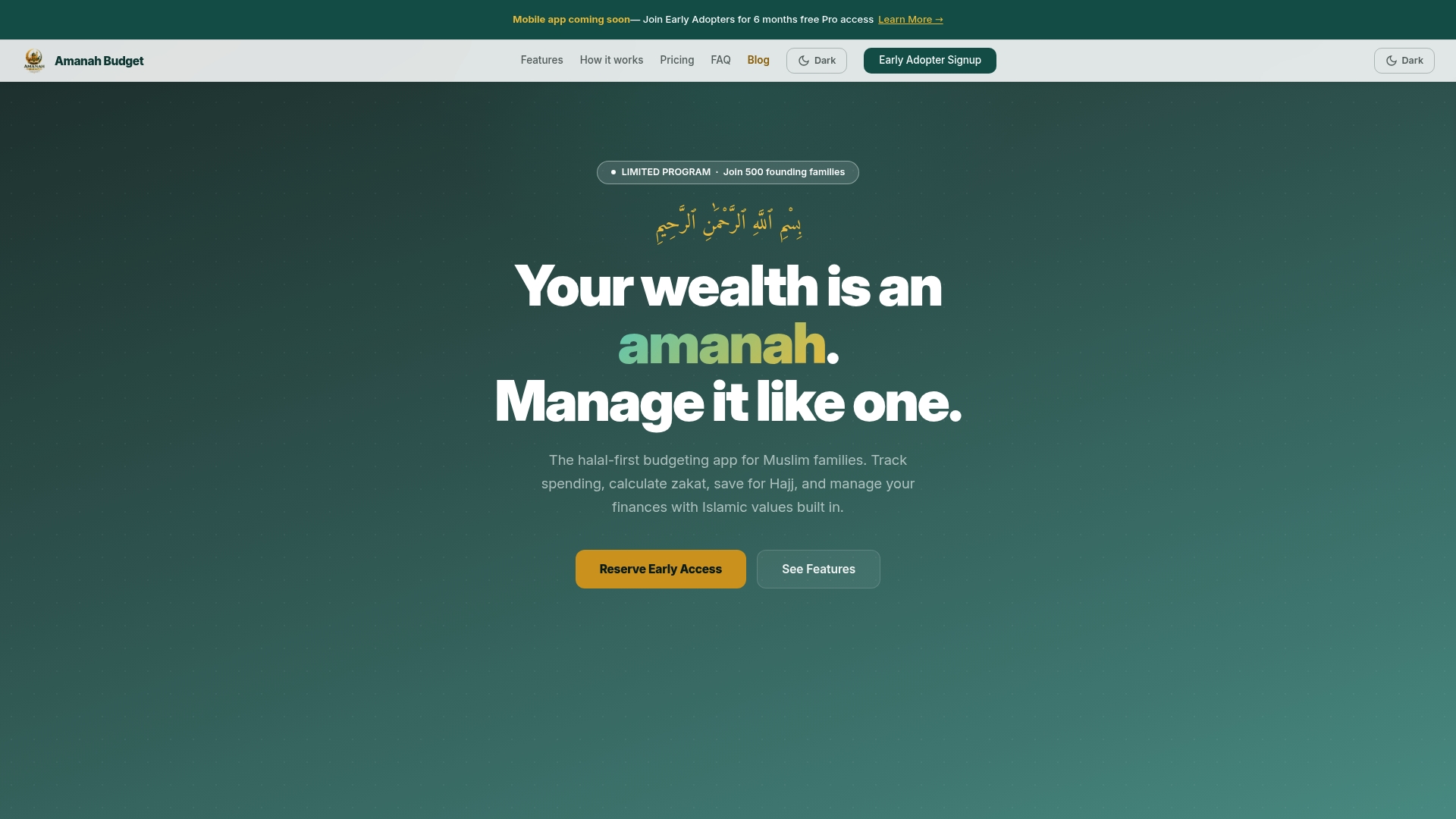
Amanahfund is a halal-first budgeting app built specifically for Muslim households. It includes halal-aware spending categories, zakat calculation by madhab, savings goals for Hajj, Umrah, Ramadan, and Eid, and shared budgeting for couples. Bank accounts connect securely through Plaid, and AI-assisted categorization handles the weekly sorting automatically. No ads, no data selling, and no interest-based products. If you are ready to put these Islamic financial planning tips into practice with a tool built for your deen and your dunya, Amanahfund is where to start.
FAQ
What is the correct way to calculate zakat for a Muslim household?
Zakat is 2.5% of each individual’s net qualifying wealth held above the nisab threshold for a full lunar year. Each spouse calculates zakat separately based on their own wealth, not the household total.
How many months of expenses should a Muslim family save in an emergency fund?
A 3–6 month emergency fund is the standard recommendation for financial resilience. Savings should be held in halal-compliant vehicles such as non-interest accounts, physical gold, or Islamic money market funds.
What are Islamic-intent budget categories?
Islamic-intent categories are obligations, halal necessities, halal discretionary, charity beyond zakat, and questionable expenses. They replace generic labels like food and entertainment to reflect Islamic financial priorities.
How does the three-account system work for Muslim couples?
Each spouse maintains a personal account for individual wealth, and a third joint account covers shared household expenses. The husband contributes nafaqah to the joint account; the wife’s personal wealth remains her own.
How often should Muslim families review their household budget?
A weekly 10–15 minute review, ideally on Sunday evenings, is the most effective habit for consistent financial tracking aligned with Islamic values.
Recommended
Ready to manage your amanah?
Track halal spending, calculate zakat, save for Hajj — all in one app. Free forever.
Create Free Account