Why Avoid Data Selling Apps: A Privacy Guide
TL;DR:
- Data selling apps collect your personal information and sell it to third parties without your clear knowledge. This practice leads to long-term privacy risks, including targeted profiling and misuse by insurers, law enforcement, and political entities. Protect yourself by regularly reviewing permissions, using privacy settings, and exercising your legal rights to delete data.
Data selling apps are defined as mobile or browser applications that collect your personal information and package it for sale to advertisers, data brokers, insurers, or other third parties, often without your meaningful knowledge. The risks of data selling apps go far beyond targeted ads. Your location history, purchase behavior, health interests, and political leanings can end up in profiles sold to landlords, law enforcement, and political campaigns. Understanding why avoid data selling apps is the first step toward protecting what belongs to you.
Why avoid data selling apps: what they actually do with your data
Most people assume apps collect data only to improve the product. The reality is more transactional. Free apps treat your personal information as the product itself, monetizing it through a chain of third parties you never agreed to interact with.
The process works in four distinct stages:
- Permission harvesting. When you install an app, it requests access to your location, contacts, camera, and microphone. Granting these permissions opens the door to continuous data collection, even when the app runs in the background.
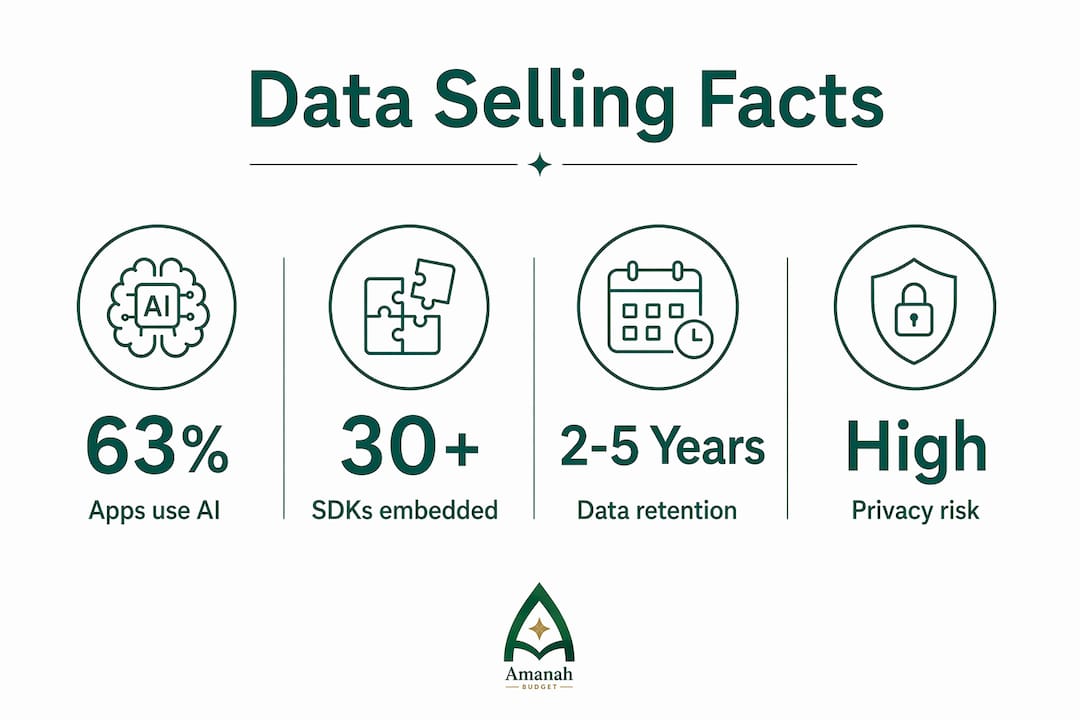
- SDK data extraction. Free apps typically embed 10–30 third-party SDKs that collect and sell user data independently of the app developer’s direct knowledge. These SDKs operate as closed-source black boxes, transmitting device IDs, location, contacts, and usage patterns to unknown third parties.
- Data broker enrichment. Raw app data flows to data brokers, who cross-reference it with records from other sources. The result is a detailed profile that includes your address, income range, health interests, and purchase history.
- Profile distribution. Brokers sell these profiles to insurers, landlords, employers, law enforcement agencies, and political campaigns. The buyer list is broader than most people expect.
The legal language enabling all of this is deliberately vague. Privacy policies use phrases like “we may sell your data” as a blanket authorization covering dozens of undisclosed recipients. Reading the full policy rarely helps because the language is designed to be broad, not transparent.
Pro Tip: Before installing any free app, search its name alongside “privacy policy data sharing” to find independent analyses. Organizations like the Electronic Frontier Foundation (EFF) regularly publish app privacy audits.
A less visible risk involves AI subprocessors. 63.6% of popular business software vendors advertising AI capabilities do not disclose third-party AI subprocessors in their legal documentation. That means your data may feed AI training systems you never approved, with no notification required.
What are the real dangers of selling personal data?
Loss of control is the defining harm. Once your data leaves an app, you cannot recall it. It moves through broker networks, gets merged with other records, and resurfaces in contexts you never anticipated.
The dangers compound over time for several reasons:
- Prolonged retention. Many apps retain user data for 2–5 years after account deletion, sometimes indefinitely unless you submit a specific deletion request. Deleting the app does not delete the data already sold.
- Re-identification from “anonymous” data. Anonymized datasets can often be re-identified by combining just a few data points, such as location history and purchase patterns, with other databases. Anonymization is not a reliable privacy protection.
- Unequal harm. Data collection risks are not distributed equally. Marginalized groups face higher privacy risks from AI models trained on sold data, as those models can encode and amplify existing biases against them.
- AI compliance failures. 32.8% of vendors engage in high-risk processing, including sensitive personal data use and automated decision-making, without disclosing it.
“Users often give consent via lengthy privacy policies that nobody reads, enabling apps to legally sell data without meaningful understanding from users. This ‘dark pattern’ consent model undermines true informed consent on data selling.”
The broker market is the part most people never see. Data brokers compile detailed profiles containing your address, income range, health interests, political leanings, purchase history, and location patterns, then sell them to multiple buyer types. A single app download can seed a profile that follows you for years.
Which types of apps are most likely to sell your data?

Not every app carries the same risk. Certain categories are structurally built around data monetization.
| App category | Primary data collected | Typical buyers |
|---|---|---|
| Free utility apps | Device ID, location, contacts | Ad networks, data brokers |
| Reward and cashback apps | Purchase behavior, store visits | Retailers, insurers, marketers |
| Free browser extensions | Browsing history, form inputs | B2B intelligence firms |
| Free games and quizzes | Demographics, social graph | Advertisers, political campaigns |
Reward and cashback apps deserve special attention. They offer small financial incentives in exchange for detailed behavioral data, including which stores you visit, what you buy, and how often. The data value to buyers far exceeds the rewards you receive.
Browser extensions carry a corporate risk that individual users rarely consider. Extensions marketed as B2B tools can capture employee system data and corporate information, selling it as competitive intelligence without triggering any breach notification. This affects businesses as much as individuals.
Pro Tip: Check the number of permissions an extension requests before installing it. A PDF viewer that asks for access to all website data is a red flag. Legitimate tools request only what they need.
Free games and quiz apps are among the most aggressive data collectors. They gather demographic information, map your social connections, and track how long you engage with specific content. That behavioral fingerprint is valuable to political campaigns and advertisers alike. The risks tied to AI-enabled finance tools follow a similar pattern, where data flows to parties far removed from the original transaction.
How can you protect yourself from data-selling apps?
Reducing your exposure requires consistent habits, not a one-time fix. The following steps address the most common points of data leakage.
- Audit app permissions quarterly. Open your phone’s privacy settings and review which apps have access to your location, microphone, contacts, and camera. Revoke any permission that does not match the app’s core function.
- Switch to approximate location. Both iOS and Android allow you to share approximate location instead of precise GPS coordinates. Use this setting for every app that does not require turn-by-turn navigation.
- Deny “always-on” tracking. Set location access to “while using the app” rather than “always.” Background location tracking is one of the most valuable data points brokers collect.
- Choose paid or privacy-focused alternatives. Paid apps have less financial incentive to sell your data because you are already the revenue source. Privacy-focused apps publish clear data minimization policies and limit third-party SDK use.
- Exercise your legal rights. Under the California Consumer Privacy Act (CCPA), California residents can request that companies delete their data and opt out of data sales. Similar rights exist under the Virginia Consumer Data Protection Act (VCDPA). Submit deletion requests directly to apps and data brokers.
Pro Tip: Use a service like Privacy.com for virtual card numbers when signing up for free apps that require payment details. This limits the financial data tied to your real identity.
Understanding app permissions and bank connections is especially important for financial apps, where the data at stake includes transaction history and account balances. For Muslim families using halal fintech apps, choosing platforms that explicitly commit to not selling user data is both a practical and values-driven decision.
Key Takeaways
Data selling apps pose serious, long-term privacy risks by distributing your personal information to brokers, insurers, and AI systems without meaningful consent, and the only reliable protection is deliberate app selection combined with regular permission audits.
| Point | Details |
|---|---|
| SDKs are the hidden pipeline | Free apps embed 10–30 third-party SDKs that collect and sell data beyond the developer’s control. |
| Deletion does not erase sold data | Apps retain data for years after account deletion; submit explicit deletion requests to brokers. |
| Anonymization is not protection | Re-identification from location and purchase data is well-documented and technically straightforward. |
| Consent language is designed to be broad | Phrases like “we may sell your data” legally authorize sharing with dozens of undisclosed parties. |
| Legal rights exist and should be used | CCPA and VCDPA give users the right to opt out of data sales and request deletion. |
Why this issue matters more than most people realize
I have spent years watching the data broker industry grow while public awareness of it stayed flat. The gap between what apps collect and what users understand has widened, not narrowed, as AI processing added another invisible layer to the chain.
What concerns me most is not the advertising use case. Targeted ads are annoying but relatively benign. The serious harm comes from data ending up with insurers who use it to adjust premiums, landlords who use it to screen tenants, and law enforcement agencies who use it without a warrant. These are consequential decisions made from data you never knowingly provided for that purpose.
The consent model is the part that should make everyone uncomfortable. Users legally agree to data selling through privacy policies designed to be unread. That is not informed consent. It is a legal formality that protects the company, not the person.
I also think the AI dimension is underappreciated. 42% of companies abandoned AI initiatives in 2025 due to data privacy concerns, which tells you that even organizations with legal and compliance teams cannot fully manage the risk. Individual users have far fewer tools to work with.
The practical answer is not to avoid all apps. It is to be deliberate. Pay for apps when you can. Read the permissions screen, not the full policy. Use approximate location. Submit deletion requests annually. These habits do not eliminate risk, but they reduce your exposure significantly.
— Imran
Amanahfund’s commitment to your financial privacy
Financial data is among the most sensitive information you share with any app. Amanahfund was built on the principle that your financial life is an amanah, a trust, and it should be treated accordingly.
Amanahfund runs no ads and sells no user data. The platform connects bank accounts securely through Plaid, uses AI-assisted transaction categorization without feeding your data to undisclosed third parties, and offers halal-aware budgeting tools designed for Muslim families. Features like automated halal savings and zakat calculation are built around your values, not around monetizing your behavior. If you are looking for a financial app that treats your data with the same care you would expect from a trusted advisor, visit Amanahfund to learn more.
FAQ
What makes an app a “data selling app”?
A data selling app is any application that collects personal information and transfers it to third parties, including advertisers, data brokers, or AI processors, in exchange for revenue. The transfer is often disclosed only in vague privacy policy language.
Are free apps always data selling apps?
Not always, but free apps with advertising revenue models are the most likely to sell user data. Apps funded by subscriptions or one-time purchases have less financial incentive to monetize personal information.
Does deleting an app stop data selling?
Deleting an app does not delete data already collected and sold. Apps retain user data for 2–5 years or longer. Submit a formal deletion request directly to the company and to any data brokers they work with.
Is anonymized data safe from misuse?
No. Anonymized datasets are vulnerable to re-identification by cross-referencing location history, purchase patterns, and other data points with external databases. Anonymization does not guarantee privacy.
What legal rights do I have against data selling?
Under the CCPA, California residents can opt out of data sales and request deletion of their personal information. The VCDPA provides similar rights to Virginia residents. Submitting these requests directly to apps and brokers is the most effective way to exercise them.
Recommended
Ready to manage your amanah?
Track halal spending, calculate zakat, save for Hajj — all in one app. Free forever.
Create Free Account