Halal College Savings Plan: A Muslim Family Guide
TL;DR:
- A college savings plan is halal only when you invest in shariah-compliant assets within qualified accounts like 529 plans, Coverdell ESAs, or UTMA accounts. The account’s religious permissibility depends on the assets held, not the account type itself.
A college savings plan is halal only when you invest in shariah-compliant assets inside qualified accounts like 529 plans, Coverdell ESAs, or UTMA custodial accounts. The tax wrapper itself carries no religious ruling. What matters is what sits inside it. Most default 529 portfolios include interest-bearing bond funds that violate riba prohibitions, so customization is not optional. It is the entire point. The 2026 annual 529 contribution limit is $19,000 per donor, and the Coverdell ESA limit is $2,000 per beneficiary. Knowing these numbers shapes how you plan from day one.
Which college savings plans support halal investments?
Shariah compliance in any education savings plan depends entirely on the underlying investment holdings, not the account type. A 529 plan opened in Nevada, Utah, or Virginia may offer shariah-screened mutual funds like Amana Funds as selectable options. That makes those state plans worth examining first.

Amana Funds are among the longest-established, SEC-registered halal mutual funds in the United States. The Amana Income Fund launched in the 1980s with support from the North American Islamic Trust and oversight from Amanie Advisors. Their track record gives Muslim families a verified, regulated starting point rather than an untested product.
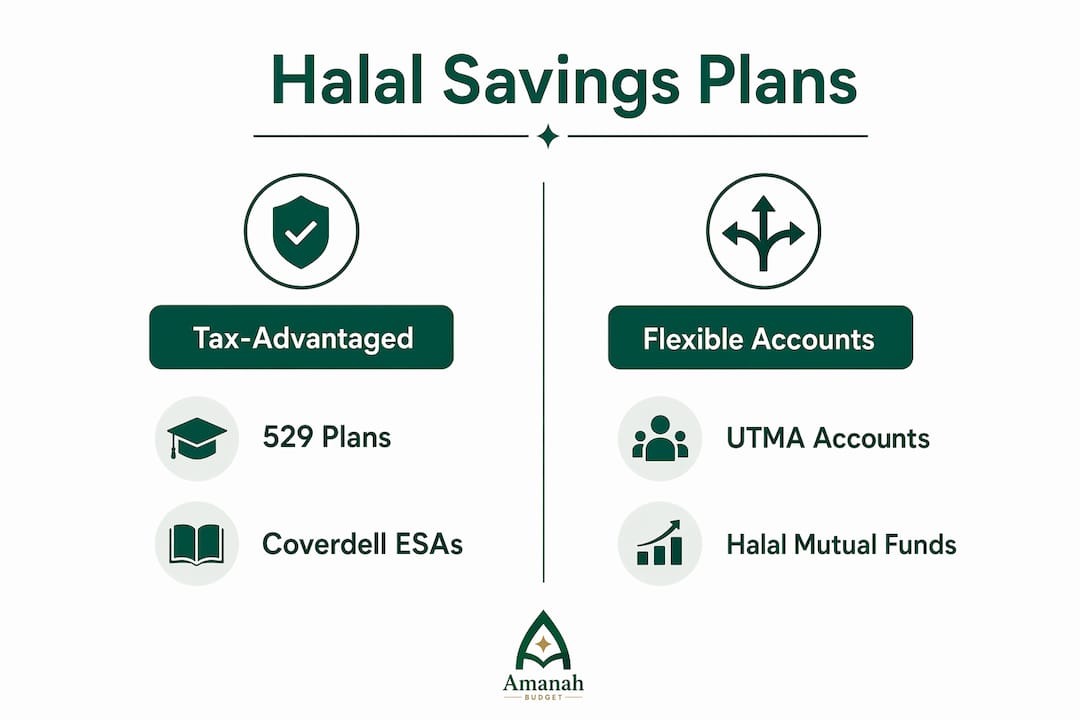
Coverdell ESAs offer full flexibility to invest in any halal ETF or mutual fund on the open market. That flexibility is their biggest advantage. The trade-off is the $2,000 annual contribution cap, which limits how much you can accumulate over time. Families with longer time horizons often pair a Coverdell ESA with a 529 plan to maximize both flexibility and contribution room.
UTMA custodial accounts carry no contribution limits and no investment restrictions. You can hold any shariah-screened ETF or fund inside one. The downside is that UTMA accounts offer no tax deferral on growth, and the assets legally transfer to the child at adulthood. That loss of control is a real consideration for many families.
| Account Type | Annual Contribution Limit | Investment Flexibility | Tax Advantage |
|---|---|---|---|
| 529 Plan | $19,000 per donor | Limited to plan menu | Tax-free growth for education |
| Coverdell ESA | $2,000 per beneficiary | Full market access | Tax-free growth for education |
| UTMA Custodial | No limit | Full market access | None (taxable growth) |
Pro Tip: Before enrolling in any 529 plan, download the plan’s investment menu and search for the words “shariah,” “Islamic,” or “Amana.” If none appear, that plan does not currently support halal investing.
Check the types of halal savings accounts available in 2026 to compare your options before committing to a single account structure.
How to structure a halal college savings portfolio over time
Building a shariah-compliant portfolio is not a one-time decision. It requires a clear structure that shifts as college approaches.
- Start equity-heavy for long horizons. With 15 or more years until college, allocate primarily to shariah-screened equity funds. These carry more short-term volatility but deliver stronger long-term growth without riba.
- Transition to Islamic fixed income within 3–5 years of college. Long-term savings should shift toward Islamic fixed-income instruments as the college start date nears. This protects capital you cannot afford to lose.
- Use riba-free fixed income options. Funds like the Azzad Wise Capital Fund offer low-volatility, riba-free options that diversify risk without violating shariah principles. These are designed specifically for this kind of capital-preservation phase.
- Respect the two-change-per-year rule. 529 plans allow only two investment changes per year. Plan your rebalancing calendar in advance. Do not react to short-term market moves or you will exhaust your changes before year-end.
- Perform annual purification. Residual non-compliant income can accumulate even in screened funds. Annual purification means calculating that amount using published ratios and donating it to charity. This maintains the halal status of your portfolio year over year.
Consistent monthly investments as low as $50 accumulate significant savings over 18 years. That figure matters because it removes the excuse that you need a large lump sum to start. Small, regular contributions compounded over time outperform sporadic large deposits in almost every scenario.
Pro Tip: Set a calendar reminder each december to review your portfolio, calculate purification amounts, and confirm your investment allocations still match your timeline. Treat it like an annual zakat review for your education savings.
What are the halal alternatives to student loans?
Conventional student loans are riba-based and not permissible under shariah. The good news is that real alternatives exist, and Muslim families in the United States have more options than most realize.
- Qard hasan loans. These are interest-free benevolent loans offered by Islamic organizations. A Continuous Charity operates in 34 states and provides shariah-compliant educational loans to Muslim students. The Qard Hasan Foundation serves primarily Texas-based families. Both organizations require applications and have eligibility criteria, so plan ahead.
- Pell Grants and federal scholarships. These are not loans. They do not require repayment and carry no interest. Maximizing Pell Grant eligibility through accurate FAFSA filing is one of the most effective halal funding strategies available.
- Merit and community scholarships. Many Islamic centers, Muslim Student Associations, and national organizations offer scholarships specifically for Muslim students. These are permissible income sources with no strings attached.
- Work-study programs. Earning income through campus employment is fully halal. Federal work-study placements often connect students with meaningful roles that also build professional experience.
- Employer tuition reimbursement. If you or your spouse’s employer offers tuition assistance, this is a halal benefit worth maximizing. Many families overlook it entirely.
Avoiding riba is not just a religious obligation. It is also a financial discipline. Families who fund education through grants, scholarships, and interest-free loans graduate with no debt burden and no ongoing haram financial entanglement. The short-term effort of applying for these programs pays off for years.
For a broader view of interest-free college financing options and practical ways to reduce costs during college, the resources available to Muslim families have grown considerably in recent years.
Common mistakes in halal college savings planning
The most common mistake Muslim families make is assuming that any 529 plan is automatically halal. It is not. Default age-based portfolios almost always contain non-compliant bond funds. Enrolling without customizing your investment selection means your savings are growing in a non-halal way from day one.
- Do not trust marketing language alone. “Halal-friendly” is not a regulated term. Verify shariah board credentials, screening methodology, fees, and transparency before investing. A fund without a named, qualified shariah supervisory board is not verified compliant.
- Check the oversight board’s qualifications. A legitimate shariah board includes scholars with credentials in both Islamic jurisprudence and finance. Names and affiliations should be publicly listed on the fund’s website.
- Compare fees carefully. Shariah-screened funds sometimes carry higher expense ratios than conventional index funds. That cost is worth paying for compliance, but you should still compare options within the halal universe to avoid overpaying.
- Build a research list, not just a shortlist. Reviewing multiple funds before committing improves due diligence. Look at liquidity, screening methodology, purification guidance, and historical performance together.
- Do not skip annual rebalancing. Maintaining halal status is an ongoing practice, not a one-time selection. Annual review and purification is the standard recommended by Islamic finance experts.
Pro Tip: Ask any fund provider directly: “Who sits on your shariah supervisory board, and where can I find their credentials?” A reputable provider answers that question immediately and in writing.
How to open and manage a halal college savings plan
Getting started is simpler than most families expect. The process follows a clear sequence.
- Choose your account type. Decide between a 529 plan in a halal-friendly state, a Coverdell ESA, or a UTMA account based on your contribution goals and investment preferences.
- Select the right state plan. If you choose a 529, research which states currently offer shariah-screened funds on their investment menu. Nevada, Utah, and Virginia have historically offered Amana Funds as options, but menus change. Verify before enrolling.
- Bypass the default portfolio. When enrolling, choose “custom allocation” or the equivalent option. Select individual shariah-screened mutual funds or ETFs like Amana Growth or the Wahed FTSE USA Shariah ETF (ticker: HLAL) rather than accepting the default age-based portfolio.
- Set up automatic contributions. Learning how to automate halal savings transfers removes the temptation to skip months. Even $50 per month compounds meaningfully over 18 years.
- Keep purification records. Each year, note the non-compliant income ratio published by your fund. Calculate the dollar amount and donate it to charity. Keep a simple spreadsheet with dates, amounts, and recipients.
- Layer in complementary funding. Scholarships, Pell Grants, qard hasan loans, and employer tuition benefits all work alongside your savings plan. No single source needs to cover everything.
| Step | Action | Key Detail |
|---|---|---|
| Account selection | Choose 529, Coverdell, or UTMA | Match to contribution goals and timeline |
| Investment selection | Pick shariah-screened funds manually | Avoid default age-based portfolios |
| Automation | Set monthly contributions | Even $50/month builds meaningfully over 18 years |
| Annual review | Rebalance and purify | Two-change-per-year rule applies to 529 plans |
| Supplemental funding | Apply for grants and qard hasan | Reduces reliance on savings alone |
Key Takeaways
A halal college savings plan is built through deliberate investment selection inside tax-advantaged wrappers, sustained contributions, and annual purification to maintain shariah compliance over time.
| Point | Details |
|---|---|
| The wrapper is not the issue | 529 plans, Coverdell ESAs, and UTMA accounts are all permissible when you select shariah-compliant investments inside them. |
| Bypass default portfolios | Default 529 allocations almost always include non-compliant bond funds; always choose investments manually. |
| Annual purification is required | Residual non-compliant income must be calculated and donated to charity each year to maintain halal status. |
| Halal loan alternatives exist | A Continuous Charity (34 states) and Qard Hasan Foundation offer interest-free educational loans for Muslim students. |
| Start small and stay consistent | Monthly contributions as low as $50 over 18 years build significant savings through compounding. |
What I have learned helping Muslim families save for college
Muslim families often come to me after years of doing nothing because they assumed every savings option was haram. That assumption costs them compounding time they can never recover. The truth is that the halal path exists. It just requires more deliberate setup than the default route.
What I have found actually works is this: verified funds with named shariah boards, automatic monthly contributions, and a simple annual review. Families who follow that rhythm consistently outperform those who chase higher returns in unverified products. The discipline matters more than the fund selection, as long as the fund is genuinely compliant.
The shift to Islamic fixed income instruments within 3–5 years of college is the step most families skip. They stay equity-heavy too long and then panic when markets dip right before tuition is due. Plan that transition deliberately, and plan it early.
One more thing: do not try to do this entirely alone. For complex situations, including large balances, multiple children, or state tax deduction questions, a certified Islamic finance advisor adds real value. The Islamic perspective on saving is rich and well-developed. You do not need to reinvent it from scratch.
— Imran
Amanahfund: built to support your halal savings goals
Muslim families deserve financial tools that reflect their values, not tools they have to work around.

Amanahfund is a halal-first budgeting app built specifically for Muslim families. It includes dedicated savings goals for education, Hajj, Umrah, and emergencies, alongside zakat calculation, halal-aware spending categories, and AI-assisted transaction tracking. You can share your household budget with your spouse, connect your bank accounts securely through Plaid, and see exactly where your money goes each month. No ads. No interest-based products. No selling your data. Visit Amanahfund to see how it fits your family’s financial life.
FAQ
What makes a 529 plan halal?
A 529 plan is halal only when you select shariah-screened investment options inside it, such as Amana Funds, and avoid default bond-based portfolios that contain riba.
What is the annual contribution limit for halal college savings accounts?
The 2026 limit is $19,000 per donor for 529 plans and $2,000 per beneficiary for Coverdell ESAs.
Are there halal alternatives to conventional student loans?
Yes. Organizations like A Continuous Charity, operating in 34 states, and the Qard Hasan Foundation offer interest-free educational loans that comply with shariah principles.
How often can I change investments inside a 529 plan?
529 plans allow only two investment changes per year, so plan your rebalancing schedule carefully and avoid reacting to short-term market movements.
Do I need to purify my halal investment portfolio every year?
Yes. Annual purification involves calculating residual non-compliant income using published fund ratios and donating that amount to charity to maintain the halal status of your savings.
Recommended
Ready to manage your amanah?
Track halal spending, calculate zakat, save for Hajj — all in one app. Free forever.
Create Free Account