How to Track Sadaqah Spending Monthly: A Clear Guide
TL;DR:
- Tracking monthly sadaqah helps Muslim families maintain clarity and discipline in voluntary charitable giving. Using simple tools like logs, spreadsheets, or apps, families should categorize donations, log quickly, and review monthly to ensure consistency. Regular reflection aligns giving with faith and strengthens financial accountability.
Sadaqah is defined as voluntary charitable giving in Islam, distinct from the obligatory zakat, which is fixed at 2.5% of eligible net wealth annually. To track sadaqah spending monthly means building a consistent record of every voluntary donation you make, organized by category and reviewed on a regular schedule. Muslim families who track their charitable donations report greater clarity about their giving intentions and stronger financial discipline overall. This guide walks you through the tools, steps, and habits that make monthly sadaqah tracking both practical and spiritually grounded.
How to track sadaqah spending monthly: prerequisites and tools
Before you log a single donation, you need a clear structure. Tracking works best when you separate your giving into four distinct buckets: annual zakat, monthly recurring sadaqah, seasonal gifts such as Ramadan and Eid contributions, and discretionary community funds. Separating these four categories prevents double-counting and stops any one bucket from quietly draining another.

Choosing your tracking method
Three methods cover most households. Each has a real trade-off.
| Method | Best for | Main limitation |
|---|---|---|
| Notebook or paper log | Families who prefer a tactile, offline record | Easy to lose; hard to total quickly |
| Spreadsheet (Google Sheets or Excel) | Households comfortable with basic formulas | Requires manual entry every time |
| Halal-first budgeting app | Families wanting automatic categorization and zakat calculation | Requires account setup and bank connection |
The right choice is the one you will actually use every month. A notebook you open daily beats a spreadsheet you abandon by week two.
What to keep for documentation
Tax rules require specific records depending on donation size. For gifts under $250, a bank record or receipt is sufficient. For any single gift of $250 or more, you need a written acknowledgment letter from the receiving organization before you file taxes. Keep these records in one folder, physical or digital, labeled by month and year.
Pro Tip: Create a dedicated email folder called “Sadaqah Receipts” and forward every donation confirmation email there immediately. At month’s end, that folder becomes your complete giving log with zero extra effort.
Muslim households should also categorize spending clearly to separate obligations from voluntary giving. Mixing zakat and sadaqah records is one of the most common errors families make, and it creates confusion during both tax season and annual zakat calculation.
How do you set up a monthly sadaqah tracker?
Setting up a sadaqah giving log takes about 20 minutes the first time. After that, maintaining it requires roughly five minutes a month. The key is treating your monthly sadaqah allocation like a recurring bill, not an afterthought.
Families often allocate 5–10% of monthly income for voluntary charity, adjusted based on their financial situation. Start by deciding your monthly sadaqah amount before the month begins, not after you see what is left over.
Step-by-step setup
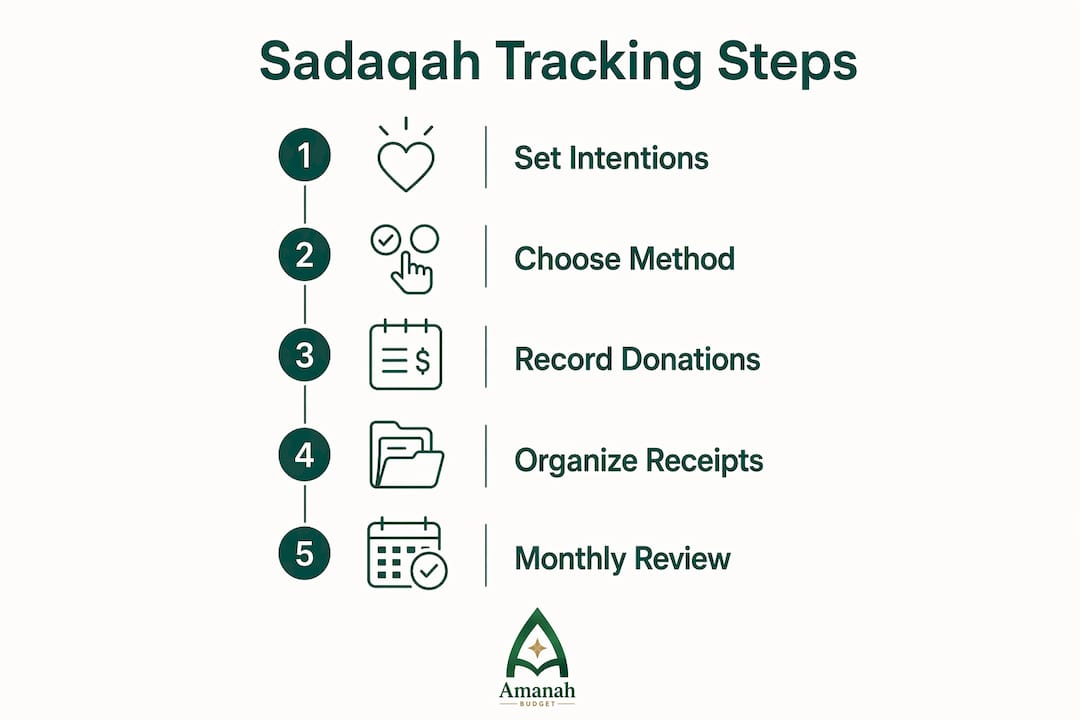
- Set your monthly sadaqah amount. Review your household income and decide a fixed percentage. Even $20 per month, given consistently, builds a meaningful sadaqah spending history over time.
- Create your four giving categories. Label them clearly: Zakat, Monthly Sadaqah, Seasonal Giving, and Discretionary. Use separate rows in a spreadsheet or separate pages in a notebook.
- Schedule a recurring monthly entry. Add a calendar reminder on the first of each month titled “Log sadaqah.” Treat it like paying a utility bill.
- Log each donation immediately. Record the date, amount, recipient, and category the moment you give. Delayed logging leads to missed entries and inaccurate records.
- Attach or file the receipt. Photograph paper receipts and save them to your dedicated folder right away.
- Run a five-minute monthly total. On the last day of the month, add up each category and compare the total to your intended allocation.
This structure aligns with guidance from Islamic finance experts who emphasize low-friction tracking systems over complex manual methods. Simplicity is what makes the habit stick.
Pro Tip: Pair your monthly sadaqah log review with an existing ritual, such as your end-of-month family budget meeting or a post-Jumu’ah reflection. Linking tracking to existing routines significantly increases how consistently you follow through.
Understanding your niyyah, or intention, behind each gift also shapes how you categorize and reflect on your giving. Amanahfund’s guide on niyyah in spending explains how intention connects directly to financial accountability in Islam.
How do you review and analyze your sadaqah spending each month?
A monthly review turns raw donation records into meaningful reflection. The goal is not just to confirm you gave, but to assess whether your giving matched your intentions and your budget.
Set a consistent review time, ideally the same day each month. During that session, ask yourself three questions:
- Did I give the amount I intended this month?
- Are my records complete, with receipts or bank confirmations for every entry?
- Are my four giving categories balanced, or is one consistently underfunded?
Measuring real-world impact
Numbers become more motivating when you connect them to outcomes. Consistent small contributions carry significant weight. For example, $10 per month over five years equals $600, enough to fund approximately 300 hot meals or 60 person-months of clean water access for someone in need. That calculation changes how you feel about a modest monthly commitment.
Review best practices
- Total each category separately before combining them. This prevents zakat from masking a shortfall in monthly sadaqah.
- Compare your actual giving to your intended allocation, not just to last month’s total.
- Note any months where you gave more than planned. Understand why, and decide whether to adjust your baseline.
- Flag any missing receipts immediately and contact the organization for a duplicate before the record becomes harder to retrieve.
- Use your monthly budget review as the anchor point for your sadaqah reflection, not a separate session.
Islamic tradition values consistency in giving over large sporadic donations. A monthly review reinforces that value by making your giving visible and intentional, not invisible and accidental.
What are the most common challenges in sustaining sadaqah tracking?
Most families who start tracking sadaqah stop within two or three months. The reason is almost always friction, not lack of intention. Daily recording feels like a burden, and when life gets busy, the log gets skipped.
The fix is reducing friction to near zero. Treating monthly sadaqah like a recurring bill and reviewing it once a month removes the daily pressure entirely. You do not need to log every day. You need to log every time you give, and review once a month.
“A ‘log-it-when-you-give’ approach paired with a monthly routine requires only five minutes for effective record-keeping and full readiness for tax season.” This principle from Islamic finance practice means your entire sadaqah expense tracking system can run on less time than a single phone call.
Common mistakes and how to fix them
- Mixing zakat and sadaqah records. Keep them in separate rows or separate sheets from day one. Merging them creates errors in both your zakat calculation and your voluntary giving totals.
- Forgetting to log a donation. Set a phone reminder that fires every time you open a charity app or website. The reminder does not need to be daily. It needs to fire at the moment of giving.
- Losing paper receipts. Photograph every receipt within 24 hours of receiving it. A blurry photo is better than no record at all.
- Skipping the monthly review. If you miss a month, do not abandon the system. Reconstruct what you can from bank statements and email confirmations, then restart the next month.
Pro Tip: For tax accountability, donors must keep receipts or bank records for gifts under $250 and obtain a written acknowledgment for single gifts of $250 or more. Store these alongside your monthly sadaqah log so tax season requires no extra searching.
Pairing your tracking habit with a couple’s finance check-in or a post-prayer reflection also builds accountability. When two people review the same record, missed entries get caught faster and the habit becomes a shared value, not a solo task. Amanahfund’s resource on spending accountability in Islam offers a practical framework for making that shared review meaningful.
Key Takeaways
Consistent monthly sadaqah tracking, built on four clear giving categories and a simple log-and-review habit, is the most reliable way to align your charitable giving with both your financial goals and your faith.
| Point | Details |
|---|---|
| Separate your giving buckets | Use four categories: zakat, monthly sadaqah, seasonal giving, and discretionary funds to prevent overlap. |
| Set your allocation before the month starts | Families typically allocate 5–10% of monthly income for voluntary charity as a starting point. |
| Log donations at the moment of giving | Immediate logging prevents missed entries and keeps your sadaqah spending history accurate. |
| Keep receipts by donation size | Gifts under $250 need a bank record; gifts of $250 or more require a written acknowledgment letter. |
| Review monthly, not daily | A five-minute end-of-month review is sufficient for complete records and tax readiness. |
Why consistency matters more than the amount you give
Working with Muslim families on their finances has shown me one pattern that repeats without exception: the families who feel most at peace with their giving are not the ones who give the most. They are the ones who give consistently and know exactly what they gave.
I have seen households donate generously during Ramadan and then feel uncertain about their sadaqah for the rest of the year because nothing was recorded. That uncertainty is uncomfortable. It creates a gap between intention and reality that no amount of good will can close.
The families who track their donations, even imperfectly, carry a different kind of confidence. They can answer the question “Did I give this month?” without hesitation. That clarity is itself a form of spiritual discipline. It reflects the Islamic principle of amanah, or trustworthiness, applied to your own financial life.
My honest advice: start with the simplest system you will actually use. A notebook and a phone reminder beats a sophisticated spreadsheet you open twice a year. Build the habit first. Refine the system later. The goal is not a perfect record. The goal is a consistent one.
— Imran
Amanahfund’s tools for your monthly giving practice
Muslim families managing both their deen and their dunya deserve financial tools built with both in mind.

Amanahfund is a halal-first budgeting app designed specifically for Muslim households. It includes halal-aware spending categories, zakat calculation by madhab, and AI-assisted transaction categorization that separates your sadaqah from your other expenses automatically. Families can also set savings goals for Hajj, Umrah, Ramadan, and Eid, and share a household budget with a spouse or family member. No ads, no interest-based products, and no selling of user data. If you are ready to bring your charitable giving and household finances into one faith-aligned system, visit Amanahfund to get started.
FAQ
What is the difference between zakat and sadaqah?
Zakat is an obligatory annual payment fixed at 2.5% of eligible net wealth. Sadaqah is voluntary charitable giving with no fixed amount or schedule.
How much should I give as monthly sadaqah?
Muslim families commonly allocate 5–10% of monthly income for voluntary charity, adjusted based on their financial situation and obligations.
Do I need receipts for sadaqah donations?
For tax purposes, you need a bank record or receipt for gifts under $250, and a written acknowledgment letter from the organization for any single gift of $250 or more.
How do I avoid mixing zakat and sadaqah in my records?
Keep them in separate categories from the start, using distinct rows in a spreadsheet or separate sections in a notebook. Never combine their totals during your monthly review.
How often should I review my sadaqah giving log?
A monthly review is sufficient. A five-minute session at the end of each month covers totaling, receipt checks, and comparison against your intended allocation.
Recommended
Ready to manage your amanah?
Track halal spending, calculate zakat, save for Hajj — all in one app. Free forever.
Create Free Account