Umrah Family Trip Budget: Your 2026 Planning Guide
TL;DR:
- A family of four from the United States should plan to spend between $3,780 and $23,000 on an Umrah trip. The total cost varies widely based on hotel proximity, family needs, and booking timing, with early reservations saving significantly. Key expenses include flights, accommodation, visas, local transportation, food, and additional child or elder care costs.
An Umrah family trip budget is the total planned expenditure covering flights, visas, hotels, transportation, food, and incidentals tailored to the needs of every family member traveling together. For a family of four departing from the USA, that figure can range from $3,780 to $23,000 depending on hotel proximity to the Haram, flight timing, and trip length. That wide range is not a flaw in the planning process. It reflects how deeply family size, comfort preferences, and travel season shape the final number. Getting the budget right before you book protects both your finances and your spiritual focus once you arrive.
What is an Umrah family trip budget made of?
The Umrah family trip budget breaks into six core categories. Each one carries its own variables, and missing even one can push your total well above what you planned.

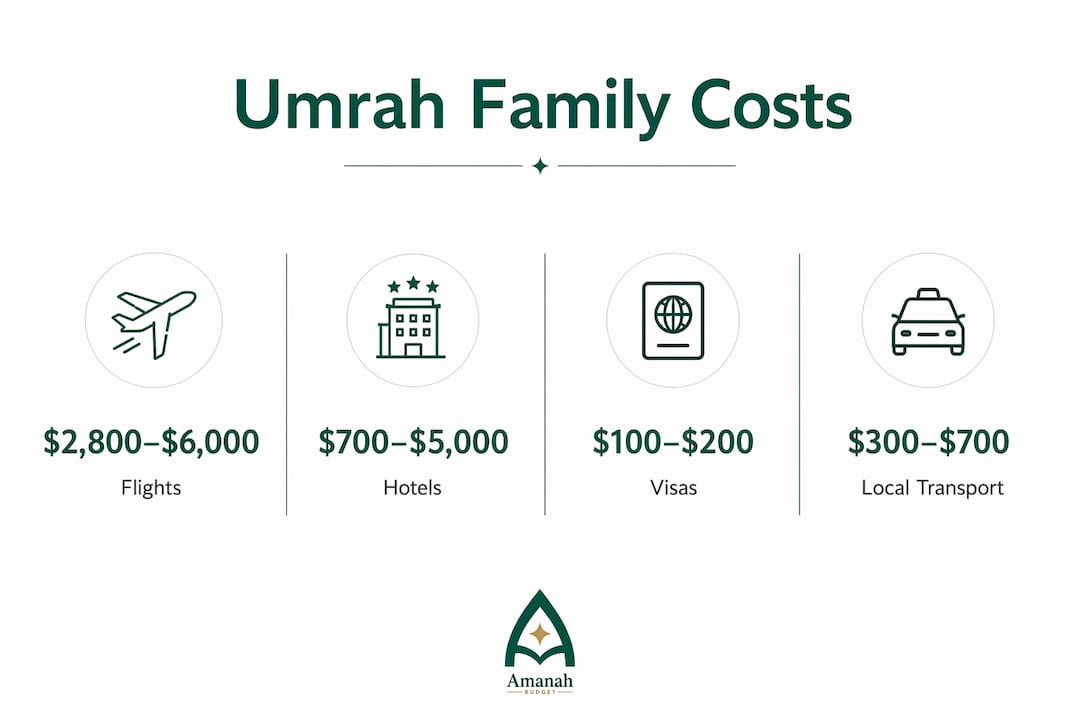
Flights are usually the largest single line item. Economy round-trip tickets from major US cities to Jeddah or Medina typically range from $700 to $1,500 per adult, depending on the season and how early you book. Children under 2 fly at 10% of the adult fare, while children aged 2 to 11 receive discounts of 25–50%. That means a family of four with two young children pays meaningfully less on airfare than four adults would.
Accommodation costs shift dramatically based on proximity to the Haram. Hotels within walking distance carry premium rates, while properties 1–2 km from the Haram cost 40–60% less. The tradeoff is real: lower room rates often mean higher transport costs and more physical fatigue, especially for families with children or elderly members.
Visa and insurance fees are fixed costs that families sometimes overlook. Saudi Arabia requires Umrah visas for all travelers, and travel insurance is mandatory. Budget for vaccinations as well, since meningitis shots are required for entry.
Local transportation covers airport transfers, daily rides between your hotel and the Haram, and intercity travel between Makkah and Madinah. Private transfers cost more than shared buses but matter significantly when you are moving with young children, strollers, or elderly relatives.
Food and daily expenses depend on your hotel package. Many family-friendly hotels include breakfast, which cuts daily food costs. Budget roughly $20–$40 per adult per day for meals not covered by your package.
Emergency buffer is non-negotiable. Unexpected medical needs, last-minute transport, or a child’s urgent laundry can add up fast. A buffer of 10–15% of your total budget is a sound practice.
| Expense Category | Estimated Range (Family of 4) |
|---|---|
| Flights (2 adults + 2 children) | $2,800 – $6,000 |
| Accommodation (7–12 nights) | $700 – $8,400 |
| Visas and insurance | $400 – $800 |
| Local transportation | $200 – $600 |
| Food and incidentals | $560 – $1,920 |
| Emergency buffer (10%) | $466 – $1,772 |
How can families plan their Umrah trip budget strategically?
The most effective method for family Umrah expenses is the per-person, per-night, per-segment cost breakdown. This approach separates fixed costs from flexible ones, which makes tradeoffs visible and prevents budget creep.
- Start with fixed costs. List airfare, visa fees, insurance, and vaccinations first. These numbers do not change once booked.
- Calculate accommodation per night. Divide your total hotel cost by the number of nights. This makes it easy to compare options at different distances from the Haram.
- Estimate transport per trip. Count how many times per day your family will travel between the hotel and the Haram, then price both private and shared options.
- Add food per person per day. Multiply your daily food estimate by the number of people and the number of days.
- Layer in child-specific costs. Add stroller rental or transport, extra snacks, urgent laundry, and any child-friendly activities separately from the adult base budget.
- Apply your emergency buffer last. Add 10–15% on top of the subtotal.
Trip timing matters as much as the math. Shoulder seasons, such as late january or early october, offer lower airfares and hotel rates than peak Ramadan or school holiday periods. A family budgeting strategy that accounts for seasonal pricing can reduce total costs without sacrificing comfort.
Pro Tip: Book your hotel before your flights. Hotel availability near the Haram fills faster than flight seats, and locking in your room first gives you a firm accommodation cost to build the rest of your budget around.
Budget packages often exclude private transfers and meals, two costs that families with children cannot easily avoid. Read every package detail before comparing prices.
What savings tips actually work for families on Umrah?
Reducing the total cost of a family pilgrimage budget does not require sacrificing comfort. The right moves simply require planning ahead.
- Book 3–6 months early. Early booking on flights and hotels saves 20–30% on total trip costs. That saving on a $10,000 trip equals $2,000 to $3,000 back in your pocket.
- Choose triple or quad-sharing rooms. Families of four or five can share one large room or a connected suite, cutting the per-person accommodation cost significantly compared to booking two standard rooms.
- Use a debit card with no foreign transaction fees. Debit cards without foreign fees or travel wallets protect you from high currency exchange costs at airport kiosks. Avoid exchanging large amounts of cash at the last minute.
- Choose hotels that include breakfast. A hotel breakfast for four people eliminates one full meal cost per day. Over a 10-night stay, that adds up to real savings.
- Compare shared buses vs. private transfers. Shared buses between Makkah and Madinah cost a fraction of private transfers. For a healthy adult group, shared transport works well. For families with infants or elderly members, private transfers are worth the premium.
- Set a firm daily spending limit. Assign each family member a daily allowance for personal purchases and souvenirs. This prevents unplanned spending from eroding your buffer.
Pro Tip: Use a halal family savings plan to set aside a fixed monthly amount toward your Umrah goal at least 12 months before your trip. Consistent saving removes the pressure of funding the trip from a single paycheck.
For broader guidance on managing family finances before a large religious trip, family financial planning principles apply directly to building a disciplined Umrah savings habit.
How does family composition affect the Umrah trip cost?
Family composition is the single biggest variable in any Umrah cost breakdown. Two families spending the same number of nights in the same hotel can have very different total bills based on who is traveling.
- Infants under 2 cost very little on flights, at 10% of the adult fare, but they require strollers, formula or snacks, and more frequent private transport. The savings on airfare often get absorbed by these ground-level costs.
- Children aged 2–11 receive 25–50% flight discounts, but they need their own seat, their own meal, and their own space in the hotel room. A family of two adults and two children in this age range often needs a larger room or a connected suite.
- Elderly family members require proximity to the Haram above almost everything else. The fatigue tax from walking long distances in heat is real, and it can turn a budget hotel 2 km away into a costly decision when you factor in daily taxis and physical exhaustion.
- Families with mobility limitations should budget for wheelchair assistance at airports, accessible hotel rooms, and private transfers exclusively. These are not optional costs.
The right approach is to build a base adult budget first, then add a child-specific layer covering strollers, snacks, urgent laundry, and private transfers. This two-layer method gives you an accurate total rather than a rough estimate that surprises you mid-trip.
| Family Type | Key Added Costs |
|---|---|
| Family with infant | Stroller, formula, private transfers, extra luggage |
| Family with children 2–11 | Extra hotel space, child meals, snacks, entertainment |
| Family with elderly members | Proximity premium, private transport, accessible rooms |
| Mixed group (all ages) | All of the above, plus higher emergency buffer |
A family halal budget setup that accounts for each family member’s specific needs produces a far more accurate plan than a generic per-person estimate.
Key Takeaways
A family of four from the USA should expect to spend between $3,780 and $23,000 on an Umrah trip, with hotel proximity, family composition, and booking timing as the three biggest cost drivers.
| Point | Details |
|---|---|
| Budget range for a family of four | Total costs run from $3,780 to $23,000 depending on hotel distance and flight timing. |
| Book 3–6 months early | Early booking saves 20–30% on flights and accommodation for the full trip. |
| Add a child-specific budget layer | Stack child costs like strollers, snacks, and private transfers on top of the adult base budget. |
| Proximity tradeoff is real | Hotels 1–2 km from the Haram cost 40–60% less but increase transport costs and fatigue. |
| Use no-fee debit cards | Avoid currency exchange losses by using a debit card with no foreign transaction fees. |
What I’ve learned about balancing budget and comfort for families
Most families I’ve seen plan Umrah underestimate two things: the fatigue tax and the child-layer costs. They find a hotel that looks affordable on a spreadsheet, book it, and then spend a third of their trip paying for taxis because the walk to the Haram is too long for their kids or their parents.
The proximity versus cost tradeoff is not just a financial question. It is a physical one. A hotel that costs $60 more per night but sits five minutes from the Haram can save a family with young children hours of daily stress. That math often works in favor of paying more upfront.
The granular budgeting approach is the one I trust most. When you price every segment separately, per person, per night, per transport leg, you see exactly where the money goes. You also see where you can cut without consequence and where cutting would hurt the trip.
The costs families most often miss are travel insurance, vaccinations, and currency exchange losses. These are not large individually, but together they can add $500 to $1,000 to a family trip that was already stretched thin. Budget for them from day one.
My honest recommendation: prioritize your family’s health and energy over squeezing every dollar. A spiritually meaningful Umrah requires presence of mind. Exhausted families do not get the most from their time in Makkah and Madinah. Spend where it protects your energy, and save where it does not cost you anything real.
— Imran
How Amanahfund supports your Umrah savings plan
Planning a family Umrah trip is one of the most meaningful financial goals a Muslim household can set. Amanahfund is built specifically for this kind of intentional saving.

Amanahfund’s halal-first budgeting tools let families set a dedicated Umrah savings goal, track progress month by month, and categorize every expense with Islamic values in mind. The app supports shared household budgets, so both spouses can monitor the plan together. There are no ads, no interest-based products, and no selling of user data. Start your Umrah savings goal with Amanahfund and give your family the financial clarity this trip deserves.
FAQ
How much does an Umrah trip cost for a family of four?
A family of four from the USA should budget between $3,780 and $23,000 for a 7 to 12-day Umrah trip, depending on hotel proximity to the Haram and flight booking timing.
When is the best time to book flights and hotels for Umrah?
Booking 3–6 months in advance saves 20–30% on total trip costs. Shoulder seasons outside of Ramadan and school holidays offer the lowest rates.
Do children get discounts on Umrah flights?
Yes. Children under 2 fly at 10% of the adult fare, and children aged 2–11 receive discounts of 25–50% on most airlines.
Should families stay close to the Haram or farther away to save money?
Hotels 1–2 km from the Haram cost 40–60% less, but the savings can be offset by daily transport costs and fatigue, especially for families with young children or elderly members.
What hidden costs do families most often miss when budgeting for Umrah?
Travel insurance, mandatory vaccinations, currency exchange losses, and child-specific costs like strollers and private transfers are the most commonly overlooked expenses in a family Umrah budget.
Recommended
- Halal Family Vacation Savings Plan: 2026 Guide — Amanah Budget Blog
- Hajj Savings Strategies List: Your 2026 Planning Guide — Amanah Budget Blog
- How Much Does Hajj Cost and How to Save for It: A Practical Guide — Amanah Budget Blog
- How Much Does Hajj Cost and How to Save for It: A Practical Guide — Amanah Budget Blog
Ready to manage your amanah?
Track halal spending, calculate zakat, save for Hajj — all in one app. Free forever.
Create Free Account